
HEART interviews Prof John Walley about improving health service delivery using the COMDIS-HSD approach

Prof John Walley, Co-Director of COMDIS-HSD

Prof John Walley, Co-Director of COMDIS-HSD


The Health and Education Advice and Resource Team (HEART) interviewed Prof John Walley for its HEART Talks series.
In this video John explains the COMDIS-HSD approach to improving health service delivery for chronic diseases focusing on primary care. The video illustrates the approach and explains the development and evaluation of a package of materials for cardiovascular diseases (CVD) and diabetes case management and prevention.
HEART is a consortium of leading organisations in international development, health, nutrition and education. It works to support the use of evidence and expert advice in policymaking, by helping time-pressured decision-makers better understand, interpret and apply health, nutrition and education evidence.

Zambian ICCM study findings shared at ICCM London Symposium

2 participants outside health facility

2 participants outside health facility

Malaria Consortium recently shared findings from their Zambian Integrated Community Case Management study at their ICCM Symposium in London. The symposium was attended by representatives of the Ugandan Ministry of Health, UNICEF, and the London School of Hygiene and Tropical Medicine. Presentations and discussions focused on Malaria Consortium’s longest running ICCM programme and its effectiveness and impact on the health of children under five.

The symposium was broadcast live online, and you can view each presentation separately here. You can also download each presentation here.

Dr Kirstie Graham talks to The Guardian about ICCM

Dr Kirstie Graham, Malaria Consortium

Dr Kirstie Graham, Malaria Consortium


In the second of a series of 3 articles, Dr Kirstie Graham of Malaria Consortium takes part in a short Q&A on the malaria and infectious diseases hub of The Guardian website. The COMDIS-HSD study in Zambia looks at how to promote the ‘rational use’ of antibiotics using one form of intervention that is increasingly being used to reduce child mortality in rural Africa: Integrated Community Case Management (ICCM). The Q&A covers why the ‘rational’ use of antibiotics is so important, as well as the link between ICCM and the rational use of antibiotics.
In the first article, Kirstie outlined why antibiotic resistance is ‘a ticking time bomb for public health’.

The ticking time bomb of antibiotic resistance

IVI antibiotics being administered at lunchtime for a worker in China

IVI antibiotics being administered at lunchtime for a worker in China


In the first of a series of 3 articles, Dr Kirstie Graham of Malaria Consortium outlines why antibiotic resistance is ‘a ticking time bomb for public health’. She introduces the issue of antibiotic drug resistance, including its spread and its effect on child mortality. Malaria Consortium has been conducting research in Zambia to understand the use of antibiotics at community level, and aim to use their research findings to better inform action in countries implementing Integrated Community Case Management (ICCM). ICCM is one form of intervention that is increasingly being used to reduce child mortality in rural Africa.
The second article will focus more on the study itself and the final article will detail some of the study findings.

Dr Zafar Ullah makes the top 3 at GBC Health Conference

Dr Zafar Ullah at the GBC Health conference

Dr Zafar Ullah at the GBC Health conference


Dr. Zafar Ullah, CEO of SEED attended the prestigious GBC Health conference in New York as a sponsored, invited speaker from 15 – 17 May 2013. 
His presentation ‘Women in the Workplace: Improving Access to Tuberculosis Care for Garments Workers in Bangladesh’ was rated in the top 3 of the 29 sessions at the conference. And it was voted in top place on Day 3, beating Jeff Sachs’ keynote address.
Congratulations to Zafar and SEED! Click here for more information on the conference.

Chief Minister of Ministry of Health and Population, Nepal, visits The Nuffield Centre

Dr Padam Chand of the Ministry of Health and Population, Nepal, presenting at The Nuffield Centre, March 2013

Dr Padam Chand of the Ministry of Health and Population, Nepal, presenting at The Nuffield Centre, March 2013


Dr. Padam Bahadur Chand, Chief of Policy Planning and International Cooperation Division, Ministry of Health and Population (MoHP), Nepal, visited The Nuffield Centre on 7th March to give a presentation to the team.
Dr Chand’s presentation was ‘Nepal’s Health Sector Programme: progress, challenges and way forward towards MDGs and beyond.’
The presentation was followed by a group meeting to discuss operational research issues and COMDIS-HSD’s support to the MoHP.

Federal Ministry of Health in Nigeria to adapt COMDIS-HSD’s guides

Professor John Walley with Dr Agan, Chief Medical Director, Calabar University Teaching Hospital

Professor John Walley with Dr Agan, Chief Medical Director, Calabar University Teaching Hospital


In March 2013, Professor John Walley visited Nigeria to discuss CVD and diabetes work with the Federal Ministry of Health. 
They are keen to adapt COMDIS-HSD’s generic package of CVD-diabetes case management and lifestyle education materials. The meeting was facilitated by Nuffield Centre alumni Drs Philip Kayode and Bernard Bene, who work in the Department of Community Health Services, responsible for non-communicable diseases. 
John also discussed opportunities to collaborate with the National TB Programme, as well as visiting Dr Akan Otu and his colleagues in the University of Calabar Teaching Hospital to advise them on how to develop their research.

Capacity building workshop on Randomised Controlled Trials

Dr Rumana Huque of SEED presents TB project protocols

Dr Rumana Huque of SEED presents TB project protocols


COMDIS-HSD partners attended a capacity building workshop which focused on running Randomised Control Trials. We spent 3 days looking at the CONSORT guidelines, monitoring fidelity, compliance and adherence, managing trials, and developing a code plan and database.  
This was followed by one-day writing workshop which focused on how to write in plain English, and writing for audiences outside of the academic and health communities. 
It was an intense workshop and partners enjoyed sharing their work and their experiences of running RCTs, as well as the challenges they face when writing for different audiences.

The COMDIS-HSD embedded approach

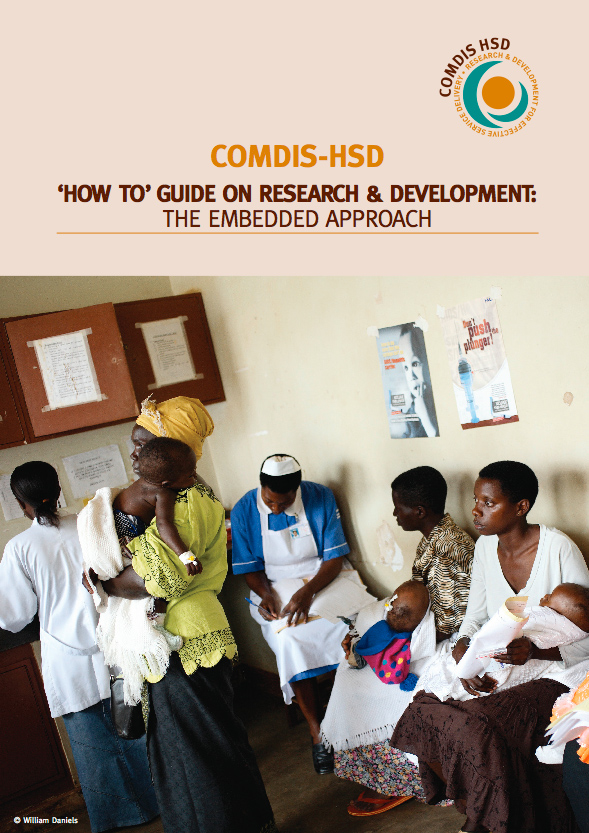
comdis-pdf-coverThe COMDIS-HSD team have produced an illustrated guide to describe the successful embedded approach used by programme partners for health research and service development. The purpose of the guide is to enable partners and other researchers to replicate the approach.
Guidance on the following is included within the document; designing and developing the service delivery package, pre-testing and piloting the package, implementing and evaluating the intervention and supporting policy and practice change nationally and internationally.
Click here for a pdf version of the document.